
Navigating Regulatory and Data Complexity in Product Safety System Transformations
Accurate, Current, and Traceable Data are Essential

Product safety and regulatory master data are business-critical in the chemical industry. Thousands of substances, raw materials, and finished products may be subject to requirements for hazard communication, registrations, and notifications, dangerous goods, customer obligations, and sustainability-related data. For U.S. operations, that can include requirements under OSHA’s Hazard Communication Standard (HCS), TSCA, and the Hazardous Materials Regulations (HMR) alongside global obligations. Accurate, current, and traceable data are therefore essential to keeping products on the market and moving through the supply chain.
Most companies manage these obligations through a connected digital system landscape rather than a single application. Core ERP systems may hold material and transactional data, while EHS and Product Safety solutions manage classifications, safety data sheets, labels, regulatory content, dangerous goods information, and compliance workflows. Platforms such as SAP, Sphera Intelligent Authoring, UL WERCS, Lisam ExESS, and company-specific solutions may all play a role.
Mergers, carve-outs, system obsolescence, regulatory change, and major technology programs can all trigger a transformation. These projects are often treated as IT migrations, but that view is too narrow. They are business and compliance transformations that determine where data will live, how regulatory decisions will be made, what the organization will depend on externally, and whether operations can continue without disruption during the transition.
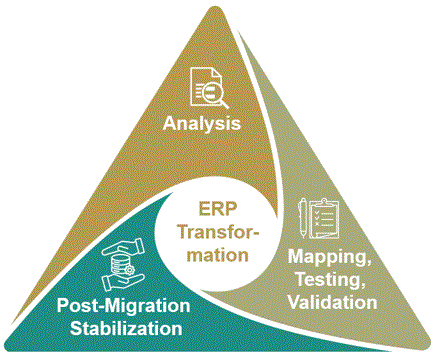
Through numerous client projects, knoell has seen the same pattern repeatedly: the technology is rarely the hardest part. The critical work is defining the future operating model, understanding which data and processes truly matter, and proving that the new environment supports the business before go-live. Based on this experience, we structure transformation efforts around three phases designed to keep Product Stewardship, Regulatory Affairs, and IT aligned from strategy through stabilization.
Phase 1: Analysis – Define the Target State
The first phase is where management choices have the greatest leverage. Before configuration and data migration starts, the organization should assess the current state and define the desired future state across data, processes, system responsibilities, regulatory content, and governance. Key questions include: Which capabilities belong in the ERP versus a dedicated Product Safety solution? Which data source is authoritative? Which regulatory content should be maintained internally or purchased? Which customizations are still justified? And what level of cost and transition risk is acceptable? These decisions should be made jointly by business, Product Stewardship, Regulatory Affairs, and IT rather than delegated to the implementation team alone.
Skipping this analysis phase often means reproducing legacy complexity in a new system and missing the intended efficiency gains. Inaccurate, redundant, or poorly owned data get migrated, obsolete custom logic is rebuilt and opportunities to simplify workflows are lost. The result may technically be a successful migration while still leaving the business with higher maintenance costs and unresolved compliance risk.
Product Stewardship and Regulatory Affairs should therefore be involved from the very beginning. They translate regulatory obligations into business requirements and help IT distinguish between a technical preference and a compliance necessity.
- Regulatory and Process Gap Assessment: Identify where the current process landscape does not support existing or upcoming requirements, where manual workarounds create risk, and where processes can be simplified. For a U.S. business, this may include impacts from OSHA’s HCS, TSCA, HMR, state-level obligations, and the need to support additional global markets.
- Target Operating Model and Architecture: Decide which processes and data belong in which system, how applications will exchange information, and where standard functionality should replace historical customization in line with clean-core principles. This is also the point to evaluate the strategic fit of different platforms and content providers rather than defaulting to the legacy setup.
- Data Readiness and Ownership: Review classifications, compositions, substance and product records, regulatory status, dangerous goods data, internal and supplier documents, and company-specific attributes before migration. Assign clear ownership and determine what should be migrated, transformed, replaced, archived, or retired.
Phase 2: Mapping, Testing & Validation – Prove It Works
Once the target state is defined, the project moves from design to evidence. Data structures, interfaces, workflows, and business rules must be mapped into the new environment and tested under realistic conditions. This is where assumptions made during design are challenged and issues are identified before they reach live operations, customers, or downstream business processes.
For chemical manufacturers, small mapping errors can have outsized consequences. A classification, phrase, unit, or inheritance rule that does not translate correctly may result in an inaccurate SDS, incorrect label, blocked shipment, customer complaint, regulatory exposure, or unsafe handling information. Validation should therefore focus not only on whether data arrived, but also on whether the regulatory meaning is preserved and downstream business outcome remain correct.
- Master Data Migration Verification: Use repeatable migration cycles and reconciliation checks to confirm that specifications, compositions, classifications, documents, and relationships are migrated completely and accurately. Check for missing fields, changed units, encoding issues, broken inheritance, or loss of historical traceability. For licensed regulatory content, confirm early what can legally and technically be transferred.
- User Acceptance Testing: Test end-to-end business scenarios rather than random records alone. Include core products and top sellers where failures can have immediate commercial impact, as well as regulatory edge cases such as complex mixtures, dangerous goods, multiple countries or languages, customer-specific requirements, and products that depend on custom logic. Verify that classifications derive correctly, SDS and labels generate as intended, regulatory or shipment controls trigger when required, and users can complete the process efficiently.
Phase 3: Post-Migration & Stabilization – Protect Business Continuity
Go-live is not the finish line. It is the point at which the new system becomes responsible for real products, real customers, and real compliance decisions. The first weeks should therefore be treated as a controlled stabilization period with clear ownership, escalation paths, and sufficient expert capacity available to resolve issues quickly before they disrupt business operations.
Even well-tested transformations reveal edge cases once real transaction volumes and user behavior hit the system. Typical problems include delayed SDS generation, incorrect classification logic, missing interface data, shipment blocks, or reporting discrepancies. Fast resolution matters because Product Stewardship processes directly affect sales, logistics, customer service, and market access.
During stabilization, Product Safety expertise shifts from design and testing to operational control and continuous improvement.
- Rapid Response Teams: Assign people who understand both the ERP functionality and the specific chemical and regulatory context. When a document, classification, workflow, or interface fails, the team needs to determine quickly whether the root cause lies in the data, configuration, integration, or regulatory logic.
- User Training & Adoption: Conduct targeted training sessions for Product Safety colleagues, chemists, safety officers, supply chain managers and customer liaisons focusing on how the new system supports their specific duties and interfaces with Product Safety and Regulatory Affairs.
- Continuous Compliance Monitoring: Go-live also marks the start of an ongoing challenge: keeping system configurations, regulatory content, and business rules aligned with continuously evolving regulations. This requires defined management-of-change processes and clear ownership for monitoring regulatory developments, assessing their impact, implementing updates, and validating that changes work as intended.
Case study: Applying the approach in an SAP S/4HANA transformation
In one SAP S/4HANA transformation, knoell was engaged in the Product Safety workstream from the planning phase through migration, User Acceptance Testing, and post-migration stabilization.
Early involvement allowed the team to identify critical data, custom logic, and business processes before migration, define representative test scenarios, and plan for sufficient Product Safety capacity during the transition. For UAT, testing was built around representative end-to-end scenarios rather than data records alone. Particular attention was given to products and processes where an error could affect regulatory output, shipment execution, or market access, including selected complex mixtures, dangerous goods scenarios, and multi-market products.

This preparation helped resolve critical issues before go-live, reduced pressure on the internal Product Safety team during the transition and supported a stable move into the new system without major disruption to business-critical processes.
The lesson is not that every transformation will run without issues. It is that early Product Safety involvement gives the organization more time to identify, prioritize, and de-risk them before they affect business continuity.
The technical migration matters, but success is ultimately measured by whether the organization can maintain compliant market access and continue selling and shipping products during and after the transformation.
For management, this translates into four questions that should be answered before go-live:
Do we have the right Product Safety capacity? Daily business continues during a transformation. Plan and
reserve capacity for analysis, testing, remediation, and stabilization so the internal team can support the project
without losing control of daily operations.
Are we moving the right data? Rationalize the portfolio and challenge unnecessary customizations before migration. Data clean-up and a simplified core architecture improve reliability while reducing long-term maintenance effort and costs.
Have we tested business outcomes, not just data? Prove that critical products can still be classified, documented, released, and shipped; regulatory controls work as intended; and downstream users receive the information they need.
Who owns the landscape after go-live? Define clear ownership for regulatory content, data quality, system changes, interfaces, and ongoing validation so governance continues after the project team leaves.
Planning a Product Safety and Stewardship system transformation? knoell can support you from target-state definition through mapping, testing and validation to post-migration stabilization. We connect regulatory requirements with system and data decisions and turn compliance needs into workable business processes.
Roland Vogt, Leader – Regulatory Affairs, Chemicals & Product Safety
knoell Germany GmbH